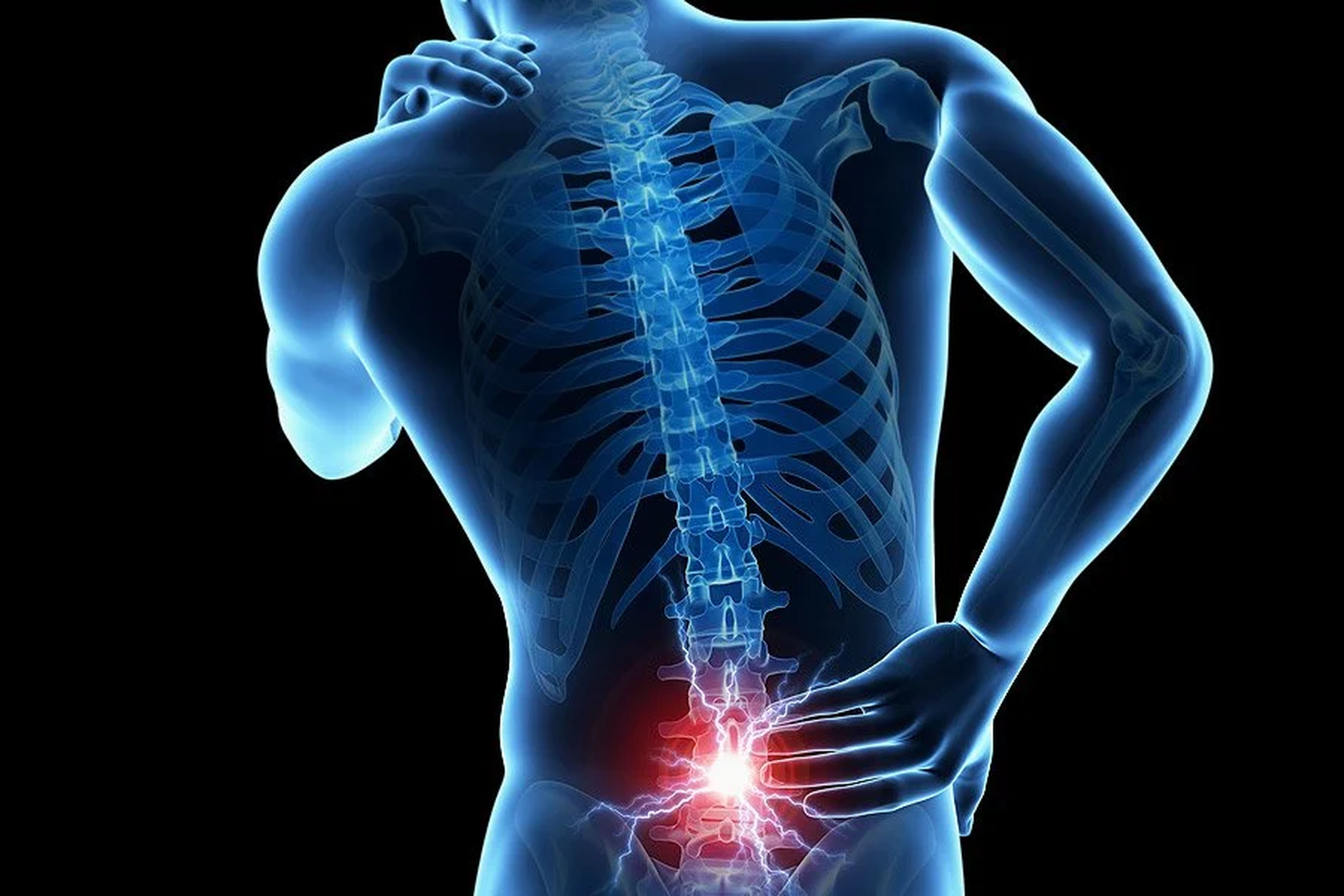
As a personal trainer with over 10 years of experience helping surfers, athletes and everyday people, I have seen a lot of people with shoulder pain and lower back pain, especially caused by surfing. But why exactly is it that so many surfers have lower back pain, shoulder pain, or both at the same time?
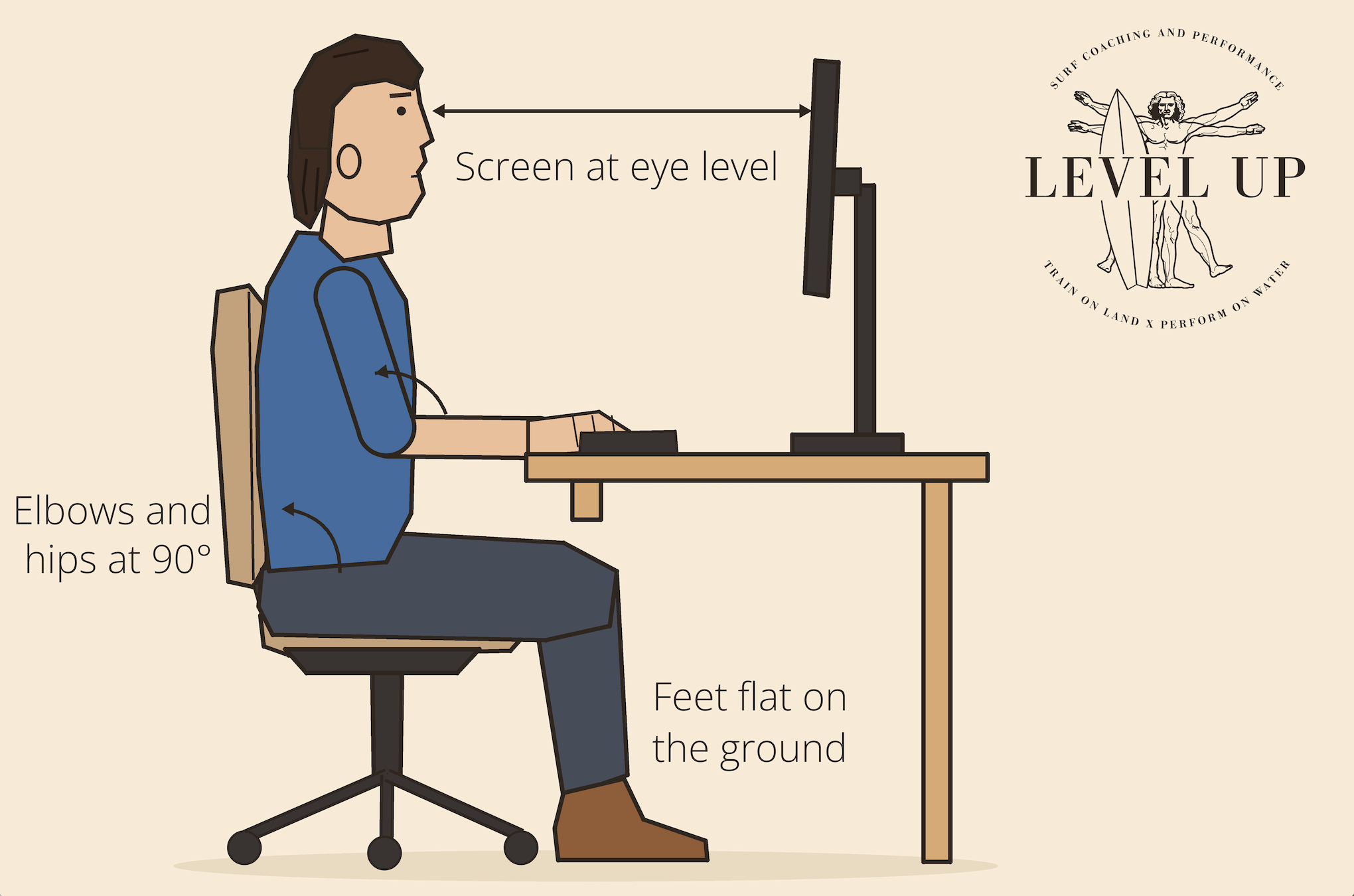
To find the answer we first have to look at the individual. Many people these days have a desk job, meaning sitting is a huge part of their day. More often than not we sit with our shoulders rolled forward and our lower backs rounded, and sometimes even twisted, depending on how we put our legs underneath the desk. The time you spend behind your desk is already a big part of the issue, and very often shoulder and lower back issues can be resolved just by changing our posture when sitting at work. Rounded shoulders can cause impingement problems, and sitting with bad posture for hours can cause back problems over a period of time.
Sitting in itself isn’t inherently bad for you, but it is how long you sit that is the main issue. Try to avoid sitting for longer than 15 minutes uninterrupted in the same position. You can do that by setting a timer to remind you to change position, or you could design your working environment in such a way that you have to move around. As an example, I once told a client of mine to put her office phone on the other side of the room, and guess what? Every time the phone went off she stood up, got out of her seated position and walked to the phone, and believe it or not, her lower back pain was gone after only a week.
Remember to try to sit with a straight, neutral back, with your screen at eye level, shoulders down and in a neutral position, and your forearms resting on the desk. Even though this is the “ideal posture” for sitting at a desk, it is still best to change position every 15 minutes.
Besides the individual’s posture throughout the day, we also have to look at what I like to call paddle posture. Some people have the worst position on their surfboards while paddling. When the chest isn’t lifted off the deck of the surfboard properly, the neck needs to overextend and the shoulders need to shrug in order to get the arms out of the water during the recovery stroke. Other people, with natural hyperlordosis in the lumbar spine or lower back region, have their chest too high on the surfboard, creating a tremendous amount of unnecessary compression in the lower back.
A bad paddle posture can also cause problems in your shoulders and lower back, and that is completely logical if you know that most of your time in the water is spent paddling around. So if your paddle posture isn’t great, it’s normal that sooner or later you’ll experience problems. Because I have seen so many surfers have these issues, I even included a monthly updated paddle posture core workout in The Level Up Surf Training Program, and I also teach paddling technique inside of The Surf Technique Blueprint for this reason.
More than half of your surf sessions is spent paddling, so the posture you have during that time is of significant importance for your back and shoulder health. Next up, I will demonstrate what good paddle posture is and give you an exercise to prevent lower back pain and shoulder pain when surfing.
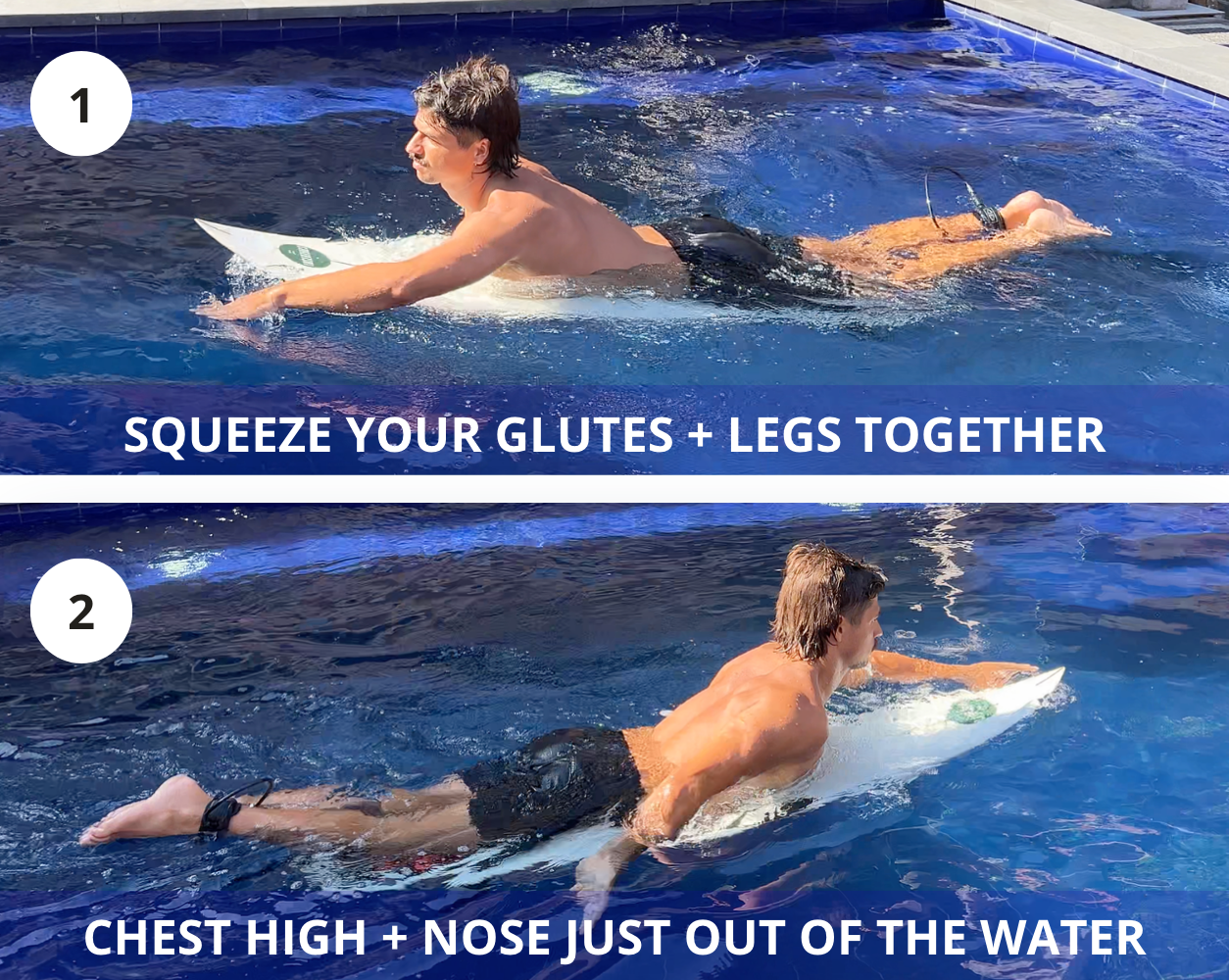
Good paddle posture starts with your position on your surfboard. You want to have your surfboard as flat on the water as possible, ideally with the nose sticking out just a couple of centimeters above the water. The flatter the board is on the water, the less drag it creates when paddling. If the nose is sticking out excessively from the water, then you are lying too far back. If the nose is underwater, then you are lying too far forward on your surfboard.
Your legs need to be closed with the feet touching each other, or some people like to rest one ankle on top of the other. Both are correct. Then the back needs to be arched and the upper chest lifted off the surfboard. We want this angle so that our shoulders can easily move over the water during the recovery stroke, and also so that we have room to change our back position. What I mean by that is that if your chest is compressed against the board, there is no room for you to change your back position because your chest is already pressed against the board. When you have a nice arch in your back, you can lower your chest whenever needed, for instance when you want to accelerate to try and catch a wave. On the other hand, being overextended and extremely high with the chest off the deck of the surfboard is also not ideal, as that causes excessive stress on the lower back, which can lead to lower back issues.
A great exercise that will target both the back muscles and the shoulder muscles is the Cobra Reverse Sand Angel. This is an exercise I often give to my clients to maintain or build strength in their paddle posture muscles.
Start by lying down on your belly. Then squeeze your glutes lightly and lift your chest off the ground to 80% of what you could maximally reach. Hold that height and start lifting the arms up as high as you can. While holding the 80% chest-high position, start moving the arms forward as if you were making angel wings. It’s the same as when you used to lie down on your back in the snow as a kid and make snow angels. If you don’t come from a cold place like I do, ignore this comparison.
Naturally rotate the shoulders as you move forward and try to touch the hands together overhead. Again, you are still holding that 80% chest-high position. From there, reverse the arm movement. Once the hands are back next to your body, curl down with the spine and bring the chest and forehead back to the ground. Going up, moving the arms forward, bringing them back next to your body and bringing the chest and head down counts as one repetition.
I advise you to aim for 3 sets of 15 repetitions with a 2-minute break between sets, every single day. Try this for 30 days and see how your lower back and shoulders respond.

Thank you for reading, and see you in the next one.