The best paddle exercises for surfers
We have all heard it before: if you want to paddle faster, you have to paddle more. Now I am about to tell you that this is not completely true. If you want to paddle faster and catch more waves, paddling more will definitely improve your paddling, but there are also exercises you can do that don't involve paddling and can improve your paddling, sometimes even more than paddling itself. If you train smart at home or in the gym with the right exercises, you can drastically improve both your endurance paddling and sprint paddling performance. In this blog, I will explain which exercises you should do as a surfer to improve your paddling and how you can start doing them at home.
Before we dive into the best paddling exercises for surfers, I first want you to understand which muscles drive the paddle stroke and what movements the paddle stroke consists of. We can divide the paddle stroke into three phases, each with its own primary muscles working to create the movement.
The first one is the initiation phase, or the part where you start pulling your arm backwards through the water. This phase is driven by your latissimus dorsi, the muscles that create the famous V-shape in a muscular back.
Then, once your hand reaches around shoulder height, we transition from the initiation phase into the propulsion phase. This is the moment when we start pushing the water backwards. This phase is still driven mainly by the lats, but now the pectoralis muscles, or your chest, also start to become involved. To straighten your arm during the final push through the water, you begin using your triceps.
Eventually, when you start lifting your arm and hand out of the water, you enter what we call the recovery phase. During this phase of the paddle stroke, we bring the arm and hand back over the water into the starting position. During the recovery phase, we use more of the rear delts, or the back of the shoulders, to lift the arm out of the water. We then bring the arm forward over the water with the help of the entire shoulder complex before entering the water again to start a new initiation phase. Besides the muscles mentioned above, there are many smaller muscles involved that are not worth discussing in this blog. For each phase of the paddle stroke, I will share my number one exercise that I use with many of my students, as well as for myself, to make sure I train specifically for better paddling.

Initiation Phase – Pull-Up
For the initiation phase, or the start of the paddle stroke, we pull our arm backwards while lying in a prone position. This means we are actually pulling our hand vertically down against resistance. The number one exercise that I like to call the king of all paddling exercises is the Pull-Up.
This exercise targets the lats extremely well. Because of the vertical nature of the movement, it also trains the muscle fibres in the same direction as when paddling, which many other exercises don't do. In a study by Coyne et al. (2017), researchers found that pull-up training not only improved sprint paddling performance but also enhanced endurance paddling in both competitive and recreational surfers. This means that by doing Pull-Ups, you can paddle for longer, extend your surf sessions, and also paddle faster, eventually making you catch more waves.
During my career as a personal trainer, I have coached many people, both men and women, from not being able to do a single repetition to performing many reps in a row for multiple sets. Just because you can't do a single Pull-Up doesn't mean that training towards your first Pull-Up won't give you the same benefits as someone who can already do 10 repetitions in a row. You simply need the right progression so that you can train the Pull-Up at your own strength level while still improving your paddling.
So what if you can't do one repetition? Then start by doing negative reps. This means you reverse the exercise and start at the top. Stand on an elevated surface so that your chest is level with the bar. Grab the bar firmly and support yourself at the top without using your feet. Now slowly lower yourself over 5 seconds until your arms are fully straight at the bottom. Congratulations, you've just done one negative Pull-Up. Step back up and repeat this for 6 repetitions.
If you can complete 3 to 5 sets of 6 negative repetitions with 3 minutes of rest between sets, you are ready to work towards your first full Pull-Up. If you can only do one full Pull-Up, perform 1 full rep followed by 5 negative reps. That counts as one set of 6 reps. Aim for 3 to 5 sets with 3 minutes rest between sets.
Only once you can do that comfortably you should progress to 2 full reps + 4 negatives, then 3 full reps + 3 negatives, and so on. This is how you build towards multiple strict Pull-Ups.
If you cannot yet do negative Pull-Ups, then train the top and bottom positions separately. Hold yourself at the top position on an elevated surface, using your feet for assistance if needed. Aim for 3 to 5 sets of 30-second holds with 3 minutes rest.
To train the bottom position, hang with straight arms and perform scapular activations. Think about creating a long neck by actively pulling your shoulders down, then relaxing back into the hang. Aim for 3 to 5 sets of 10 reps with 3 minutes rest.
Train Pull-Ups 1 to 3 times per week, with at least one rest day in between sessions.

Propulsion Phase – Dip
If the Pull-Up is the king of all paddle exercises, then the Dip is the queen. This exercise has also been shown in this scientific study Coyne et al. (2017), to improve both sprint and endurance paddling performance.
During the Dip, we push ourselves up using mainly our chest (pectoralis muscles) and triceps. These are the same muscles responsible for the propulsion phase of paddling, where we explosively push the water backwards. Because of its vertical nature, the Dip, just like the Pull-Up, trains the muscle fibres in a way that transfers well to paddling.
If you can perform full Dips, that’s great. If not, start with negative reps. Stand on an elevated surface so you can reach the top position with straight arms. Slowly lower yourself over 5 seconds until you reach the bottom position. Go as deep as you can comfortably control. Step back up and repeat for 6 repetitions.
If needed, use your feet for assistance and think of your feet as standing on a scale. Your goal is to make that scale show as little support as possible. Perform 3 to 5 sets of 6 repetitions with 3 minutes rest.
If you can do 1 full Dip, perform 1 full rep followed by 5 negatives. Progress in the same way as the Pull-Up: 1+5, then 2+4, then 3+3, and so on.
Dips can be done at home using parallel bars or two sturdy chairs. The propulsion phase is your final acceleration in the paddle stroke so make that push counts.

Recovery Phase – Reverse Sand Angel
Once the hand exits the water, the recovery phase begins. This is where many undertrained surfers feel a burning sensation in their upper back and neck. My favourite exercise for this phase is the Reverse Sand Angel.
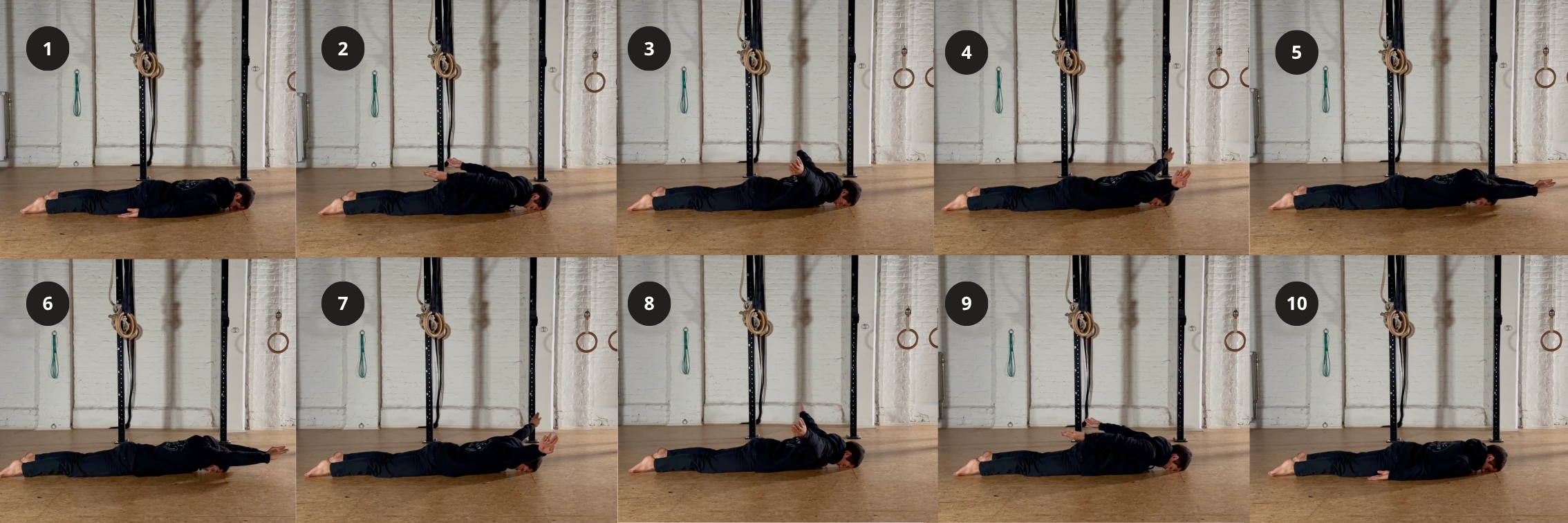
Lie in a prone position on the floor. Lift your arms behind you with palms facing up and raise them as high as possible off the ground. Then move your arms forward while rotating the shoulders naturally, bringing the hands overhead without touching the ground, before returning to the starting position. One full cycle is one repetition.
If you cannot lift your arms overhead, place a small pillow under your chest. This reduces difficulty while still allowing full range of motion. Even then, try to reach as high as possible.
Perform 3 to 5 sets of 10 slow repetitions with 3 minutes rest. To progress, hold a 1-litre water bottle in each hand. The better you become at performing this exercise the more efficient your paddling will become.
Full Paddle Position – Cobra
As a bonus, here is one exercise that trains an important part of all three phases of the paddle stroke.
When lying on a surfboard, we are in a position of spinal hyperextension, especially in the lower back. Outside of surfing and early childhood, this position is rarely used. That’s why many surfers experience lower back issues or struggle to maintain an efficient paddling posture.
The exercise is called the Cobra.
Lie on the floor. Lift your head and look forward. Raise your chest as high off the ground as possible while lifting your arms behind you. The Cobra is an isometric exercise, meaning we hold the top position for up to 1 minute. To make it harder, bring the arms forward to increase leverage.
The erector spinae muscles, which extend the spine, are often undertrained. If you suddenly go surfing or on go on a surf trip without preparing them, it is normal for your lower back to become sore.
Hold for 1 minute, aiming for 3 to 5 sets with 3 minutes rest. If needed, place a small pillow under your chest.

And there you have it, the best exercises to improve your paddling as a surfer. These exercises have helped me and many of the surfers I coach paddle faster and for longer. By doing these exercises consistently, you will increase your wave count and spend more time in the water.
If you need help with your training, consider joining my online surf training program. You can subscribe monthly to prepare for a surf trip, or yearly to stay fit for surfing all year round.
Thank you for reading.
See you in the lineup.